
Drawer Organization
Cutlery, utensils, spices, knives, plates, wraps, containers, charging, grooming, and drawer-box planning.
Explore this page →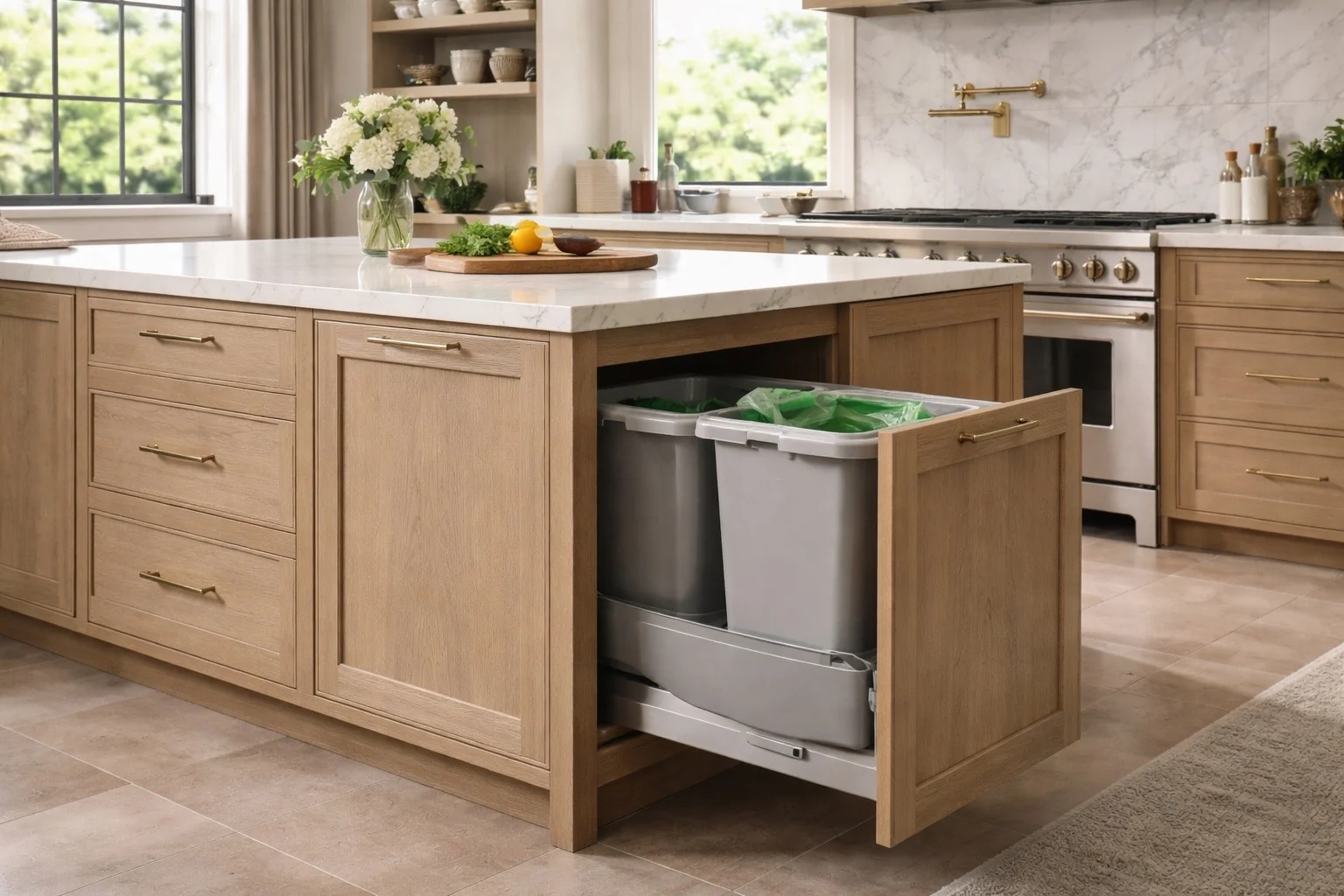
Integrated waste and recycling cabinets are used constantly. The right system depends on bin size, household habits, prep location, sink and dishwasher flow, guide strength, cleaning access, and how much cabinet space the solution deserves.
The best waste system is not simply the largest bin that fits. It is the system that matches how the household cooks, cleans, recycles, composts, entertains, and unloads the dishwasher.
Main kitchen cleanup, prep islands, secondary prep sinks, coffee bars, laundry rooms, mudrooms, pet zones, and high-use utility areas.
Integrated bins reduce visible clutter, shorten cleanup steps, and keep trash or recycling close to the work zone.
A waste pull-out can become heavy, messy, undersized, or poorly located if bin size, guide strength, and cleaning access are not planned.
Waste systems need correct cabinet width, bin height, pull-out frame, guide rating, door attachment, liner access, and clearance from plumbing or appliances.
Good storage is not about adding every available accessory. It is about assigning the right type of storage to the right zone, then confirming that the cabinet, drawer box, guide system, and accessory hardware can support how the space will actually be used.
Cutlery, utensils, spices, knives, plates, wraps, containers, charging, grooming, and drawer-box planning.
Explore this page →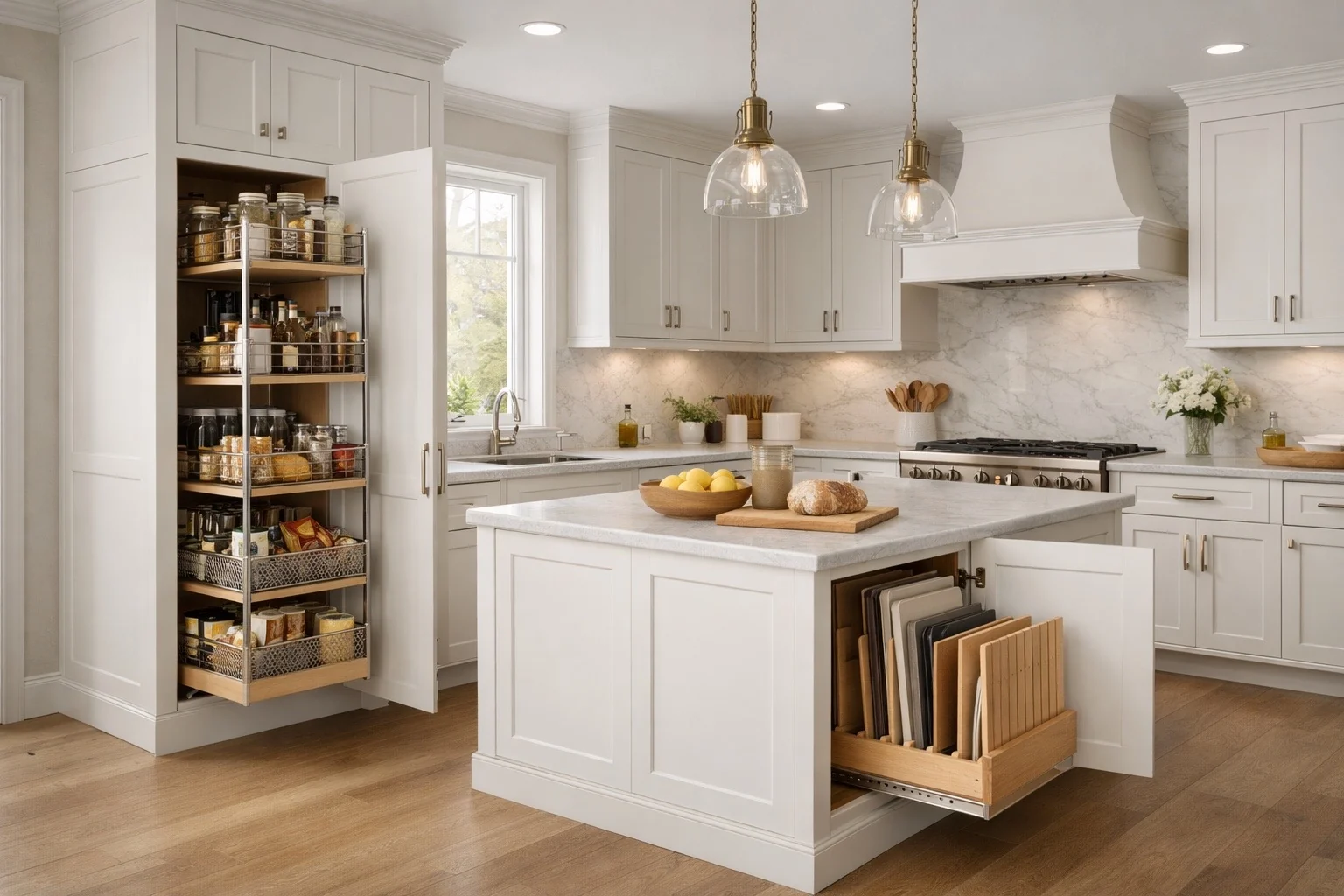
Roll-out trays, pantry pull-outs, spice units, tray dividers, mixer lifts, blind corners, and movement hardware.
Explore this page →Single-bin, double-bin, recycling, compost, cleanup-zone placement, bin size, soft-close systems, and cleaning realities.
Explore this page →Common integrated systems include single-bin, double-bin, top-mount, bottom-mount, door-mount, soft-close, overtravel, and specialty assisted-opening systems. Many projects use 34/35-quart or 50-quart class bins, but the right size depends on cabinet width, household volume, and how often the bins are emptied.
Best for compact kitchens, secondary zones, laundry rooms, or clients who separate recycling elsewhere. Simple, efficient, and often easier to clean.
Best for trash and recycling in one cabinet. It uses more cabinet space but gives a cleaner workflow for households that separate daily.
Best for households with higher trash volume. They reduce emptying frequency but become heavier and require careful guide and cabinet planning.
Best where cabinet space is limited or where bins are emptied frequently. Often a good balance of size, weight, and cabinet footprint.
Best when food prep produces daily scraps. It should be close to prep and easy to remove, clean, and seal.
Best when the client wants cleanup supplies grouped together. These systems can be efficient but need space for both roll access and bin clearance.
Best when base cabinet space is limited elsewhere, but plumbing, disposal, filters, and cleaning supplies can make under-sink waste more constrained.
Best when hands-free convenience is valuable. These systems add complexity and should be selected when the benefit is clear.
Best for vanities, laundry rooms, mudrooms, and pet zones where smaller pull-outs or hampers may solve a daily-use problem without taking kitchen space.
The visible drawer front is the finished face. The drawer box is the structure that carries the contents. When storage planning gets serious, the drawer box matters as much as the organizer because the organizer sits inside the box and adds its own weight, thickness, and clearance requirements.
A common premium cabinet drawer box uses solid maple sides with dovetail joinery, a clear or furniture-grade interior finish, and an undermount guide system. The benefit is strength, a clean interior, and a drawer that reads more finished when opened.
Frameless or full-access construction typically allows more usable drawer-box width because there is less face-frame structure around the opening. This can matter in utensil drawers, wide cookware drawers, and narrow accessory cabinets.
Face-frame cabinetry can still use strong dovetail boxes and full-extension undermount guides, but the face frame affects opening width and drawer-box sizing. The result is often a slightly different usable interior than full-access construction.
Shallow drawers work for cutlery, flat tools, wraps, and small accessories. Mid-height drawers work for utensils and containers. Deep boxes work for cookware, dishes, small appliances, bulk goods, and taller storage inserts.
A roll-out tray is a drawer-like shelf behind doors. It can improve access inside a base or tall cabinet, but it adds hardware, reduces a small amount of interior space, and usually requires enough cabinet depth for the guide system to operate.
Some projects use metal drawer box systems instead of traditional wood dovetail boxes. These can offer very clean sides, high load ratings, sleek modern styling, and coordinated organizer systems, especially in contemporary cabinetry.
Many quality cabinet lines use full-extension undermount soft-close guides. Some standard drawer-guide packages are rated around 75 pounds, while higher-capacity dovetail systems and heavy-duty concealed runners can move into higher ratings. For example, Blum MOVENTO includes 125-pound and 170-pound static-load programs, plus a waste/recycle application with its own rating. The practical takeaway is simple: cookware drawers, dish drawers, large pantries, mixer lifts, and waste pull-outs should be planned as load-bearing storage, not just empty cabinet openings.
The rating also needs context. A static rating describes a load at rest under a test standard. Daily use is dynamic: the drawer is pulled, pushed, extended, closed, sometimes leaned on, and sometimes loaded unevenly. The actual performance depends on drawer width, depth, box construction, fastener holding, cabinet anchoring, accessory weight, installation, and whether the weight is distributed evenly.
A beautiful kitchen can feel awkward if the trash is too far from the sink, dishwasher, or main prep surface. During real use, clients scrape plates, peel vegetables, open packages, rinse dishes, unload containers, and throw away wrappers. The waste cabinet should support those motions.
In many kitchens, the strongest location is near the sink and dishwasher, or in the island near the main prep surface. In larger kitchens, a secondary small waste pull-out may make sense at a coffee bar, beverage area, or secondary prep zone.
Large bins can be convenient, but they become heavier when full and can hold odor longer. Smaller bins are easier to remove and clean, but they require more frequent emptying. Recycling volume depends heavily on the household, local recycling rules, cooking frequency, packaged goods, and whether cardboard is handled elsewhere.
Larger households or frequent entertainers often benefit from larger or double-bin systems. Smaller households may prefer easier-to-clean compact bins.
Clients who cook daily usually need waste close to prep. Takeout-heavy households may generate more packaging and recycling than food scraps.
Some clients want trash and recycling together. Others prefer recycling in a pantry, garage, mudroom, or separate utility zone.
Compost bins should be small enough to empty frequently and easy to remove for cleaning. Odor control and liner habits matter.
Bin size is constrained by the cabinet opening, door style, guide hardware, and whether the system uses one bin, two bins, or an accessory frame.
A full waste bin can be surprisingly heavy. The guide system and door attachment should be chosen for daily loaded movement.
Waste cabinets are opened repeatedly, often with wet hands, food residue, and a full bin. The pull-out frame, guide system, door attachment, and cabinet anchoring all matter. Some waste systems use standard bottom-mount hardware. Others use dedicated overtravel or heavy-duty concealed runners so the bins extend farther and are easier to remove.
Soft-close movement is valuable because a loaded waste pull-out can be noisy and forceful. Push-to-open or electric-assist options can be useful in a modern kitchen, but they should be chosen with realistic expectations around cost, adjustment, power access, service, and daily habits.
That cabinet space could otherwise become drawers, trays, cookware storage, cleaning storage, or a base organizer. Waste placement should be intentional because it occupies prime real estate near the sink, dishwasher, prep zone, or island.
Excellent for cleanup, but it can compete with dishwasher placement, sink plumbing, cleaning supplies, and prep drawer locations.
Excellent for food prep, but the pull-out must avoid seating conflicts, walkway conflicts, and direct interference with other island storage.
Can preserve island drawers, but may add steps during prep and cleanup if placed too far from the actual work zone.
Convenient for separation, but they require more width and can reduce storage available for cookware, drawers, or pantry overflow.
Create an integrated look and one-motion access, but the door panel and hardware need to stay aligned under repeated loaded use.
Useful when space is tight, but plumbing and disposal equipment often reduce bin size and cleaning access.
Food residue, moisture, liners, leaks, and odor can damage the experience of a beautiful kitchen if the waste cabinet is not easy to clean. Bins should lift out cleanly. The cabinet bottom should be protected from leaks. Guides should stay free of debris. Liners should fit the bin without sliding down into the cabinet.
Remove bins and wash them as needed. A clean bin matters more than a hidden bin.
Leaking liners can damage cabinet bottoms and create odor. Wipe spills immediately and keep spare liners nearby.
Food debris can fall near the guide system. Keep tracks and surrounding cabinet surfaces clean and dry.
Do not push waste systems beyond their intended load. Heavy bags should be lifted carefully rather than dragged against the cabinet.
A waste pull-out may not be ideal if the cabinet is too narrow, the sink base is crowded with plumbing, the client needs more drawer storage, the location conflicts with dishwasher loading, or the household produces more waste than an integrated bin can handle. In some cases, a smaller integrated bin plus a larger utility-zone bin is better than forcing all waste into one kitchen cabinet.
Integrated compost also needs honest expectations. It is convenient near prep, but it should be emptied often and cleaned well. A large compost bin that sits too long can create odor and maintenance problems.
The right bin system depends on how often the client cooks, how much packaging enters the home, whether recycling is separated, whether compost is used, and how often the household wants to empty bins.
A single-bin or smaller double-bin system may be enough when cooking volume is low or recycling is handled elsewhere.
A larger single bin or double-bin system near prep and cleanup is often worth prioritizing because it is used constantly.
Double-bin storage or a dedicated secondary recycling location helps prevent recycling from collecting on the floor or counter.
Plan a small, easy-clean container and a practical emptying routine. Compost works best when odor, moisture, and access are addressed honestly.
Capacity and location become more important than novelty. A bin that is too small will become a daily irritation.
Consider a main waste cabinet plus a secondary bar, pantry, or island location so guests and hosts are not sharing one crowded cleanup point.
The sink base is one of the most contested cabinets in the room. Sink depth, drain position, disposer, instant hot, RO filtration, soap lines, air switches, and cleaning supplies can all compete for the same space. A waste pull-out may work in some sink-base conditions, but it should not be assumed.
In many designs, the strongest solution is to place waste immediately beside the sink rather than under it. This preserves plumbing access while still keeping cleanup close to the work zone.
The waste cabinet is only one part of the cleanup zone. The nearby drawers and pull-outs decide whether the client has a place for liners, towels, dishwasher supplies, containers, and sink tools.
A shallow drawer near waste keeps liners, small bags, and wraps easy to reach without leaving boxes on the cabinet floor.
Dish towels, microfiber cloths, and everyday cleaning cloths work well in a shallow or medium drawer near the sink.
Tablets, rinse aid, brushes, and small cleaning tools should be near the dishwasher but separated from food and flatware.
Food storage containers are often used during cleanup. A nearby deep drawer with dividers can reduce the common lid-and-container mess.
A tip-out can hold small sponges or sink tools when appropriate. It is not a replacement for larger cleaning storage.
A dedicated cleaning pull-out or controlled under-sink area is useful when sprays, brushes, gloves, and refills need to stay contained.
Two homes with the same kitchen size can need different waste plans. Cooking frequency, recycling habits, composting, entertaining, children, pets, and municipal collection all change the best solution.
Prioritize a main waste pull-out near prep and cleanup, often with compost or recycling nearby if those habits are consistent.
Consider double-bin systems or a secondary recycling location so bottles, cans, boxes, and packaging do not crowd the main trash bin.
Consider a secondary bar or beverage waste point for cans, bottles, napkins, coffee, and party cleanup.
Choose capacity carefully. A single larger bin may be more useful than two small bins if cabinet width is limited.
Waste in the island can be excellent, but open-pullout aisle clearance must be confirmed so the kitchen still functions.
When plumbing dominates the sink base, move the waste pull-out to an adjacent base cabinet rather than forcing a poor under-sink solution.
A lid can help visually and may reduce exposure, but it can also add one more surface to clean. Compost can be highly useful near prep, but only when the household empties and cleans it regularly. Recycling bins often need enough volume for bulky items; otherwise, bottles and packaging collect outside the cabinet.
The most reliable waste plan is easy to use and easy to clean. If a system requires too many steps, the household will often bypass it. If the bins are too small, the cabinet becomes frustrating. If the location is wrong, trash migrates to the counter.
Waste systems handle moisture, food residue, spills, liner leaks, and heavier shifting loads. That makes cleaning access, removable bins, cabinet floor protection, and early adjustment especially important.
Bins should lift out easily so the cabinet can be cleaned and the bins can be rinsed or replaced.
The cabinet floor below the pull-out should remain reachable. Liners may help, but they do not replace routine cleaning.
Crumbs, bag edges, and debris can affect movement. Tracks and frames should stay clean and unobstructed.
Door-mounted waste fronts should be watched for rubbing or shifting because they are used frequently and carry working load.
Food liquid, cleaning residue, and damp bags should not sit against finished cabinet surfaces.
Bins are wear items. A practical waste system should use bins that can be removed, cleaned, and replaced when needed.
The right waste and recycling system can make the kitchen feel calmer every day. We review placement, bin size, drawer guide capacity, liner habits, and cabinet tradeoffs before the waste cabinet becomes part of the final layout.