
Drawer Organization
Cutlery, utensils, spices, knives, plates, wraps, containers, charging, grooming, and drawer-box planning.
Explore this page →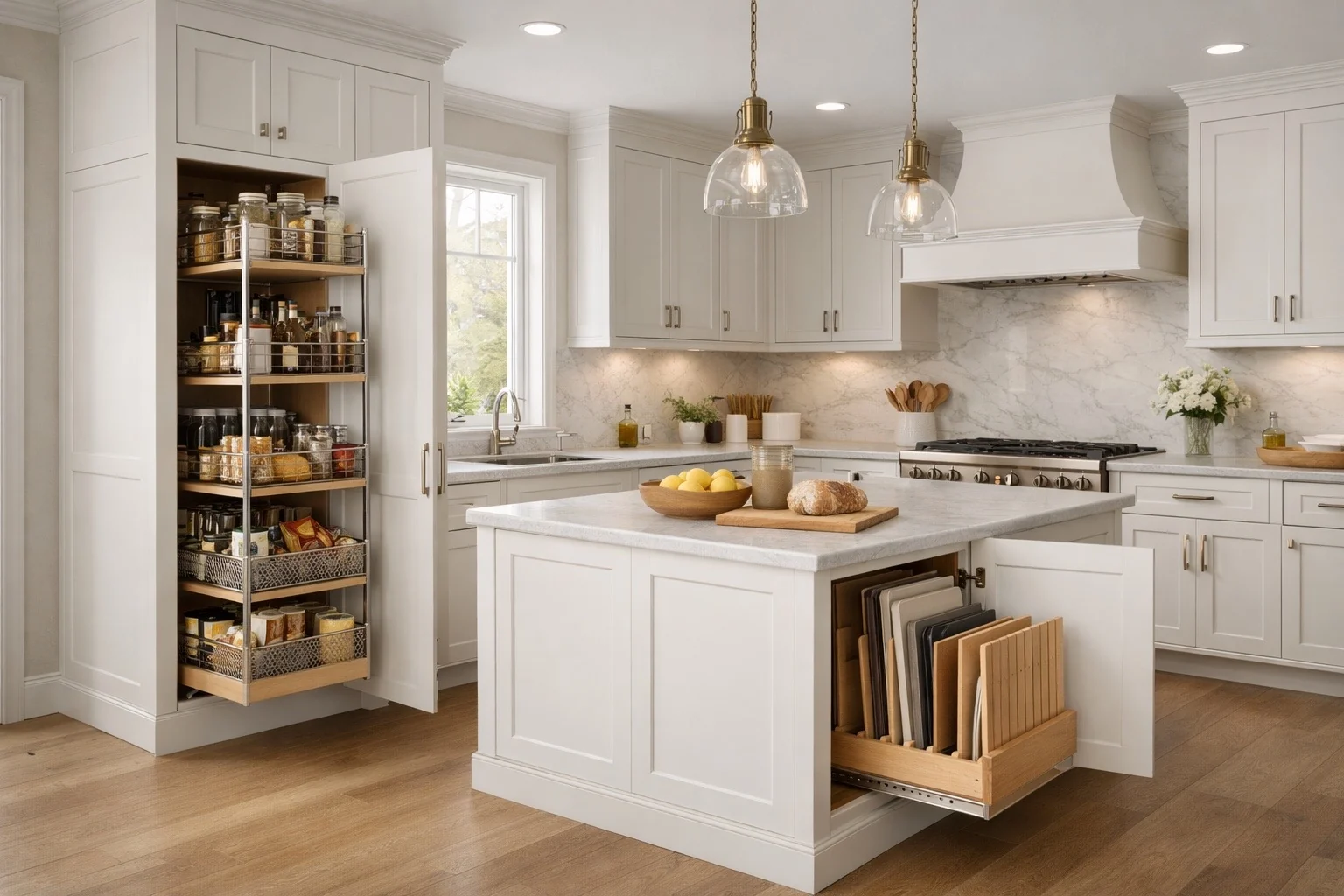
Pull-out storage is valuable when it brings hard-to-reach contents forward, organizes a narrow category, or makes a deep cabinet more usable. It needs the right cabinet depth, guide system, load rating, door clearance, and daily-use logic.
Pull-outs can solve real problems: hidden pantry goods, inaccessible shelves, narrow vertical storage, cleaning products, trays, spices, mixer storage, and blind corners. They can also reduce usable space or create maintenance issues when added without a clear reason.
Base cabinets, tall cabinets, pantry areas, tray storage, cooking zones, cleaning zones, narrow fillers, blind corners, and heavy appliance storage.
Pull-outs bring contents forward so clients do not have to crouch, reach, empty the front of a cabinet, or lose items in the back.
Every pull-out consumes space for guides, frames, clearances, and hardware. A deep drawer can sometimes be simpler and better.
Depth, width, load rating, door mounting, interior height, and whether the cabinet has been modified all affect what can be installed.
Good storage is not about adding every available accessory. It is about assigning the right type of storage to the right zone, then confirming that the cabinet, drawer box, guide system, and accessory hardware can support how the space will actually be used.
Cutlery, utensils, spices, knives, plates, wraps, containers, charging, grooming, and drawer-box planning.
Explore this page →Roll-out trays, pantry pull-outs, spice units, tray dividers, mixer lifts, blind corners, and movement hardware.
Explore this page →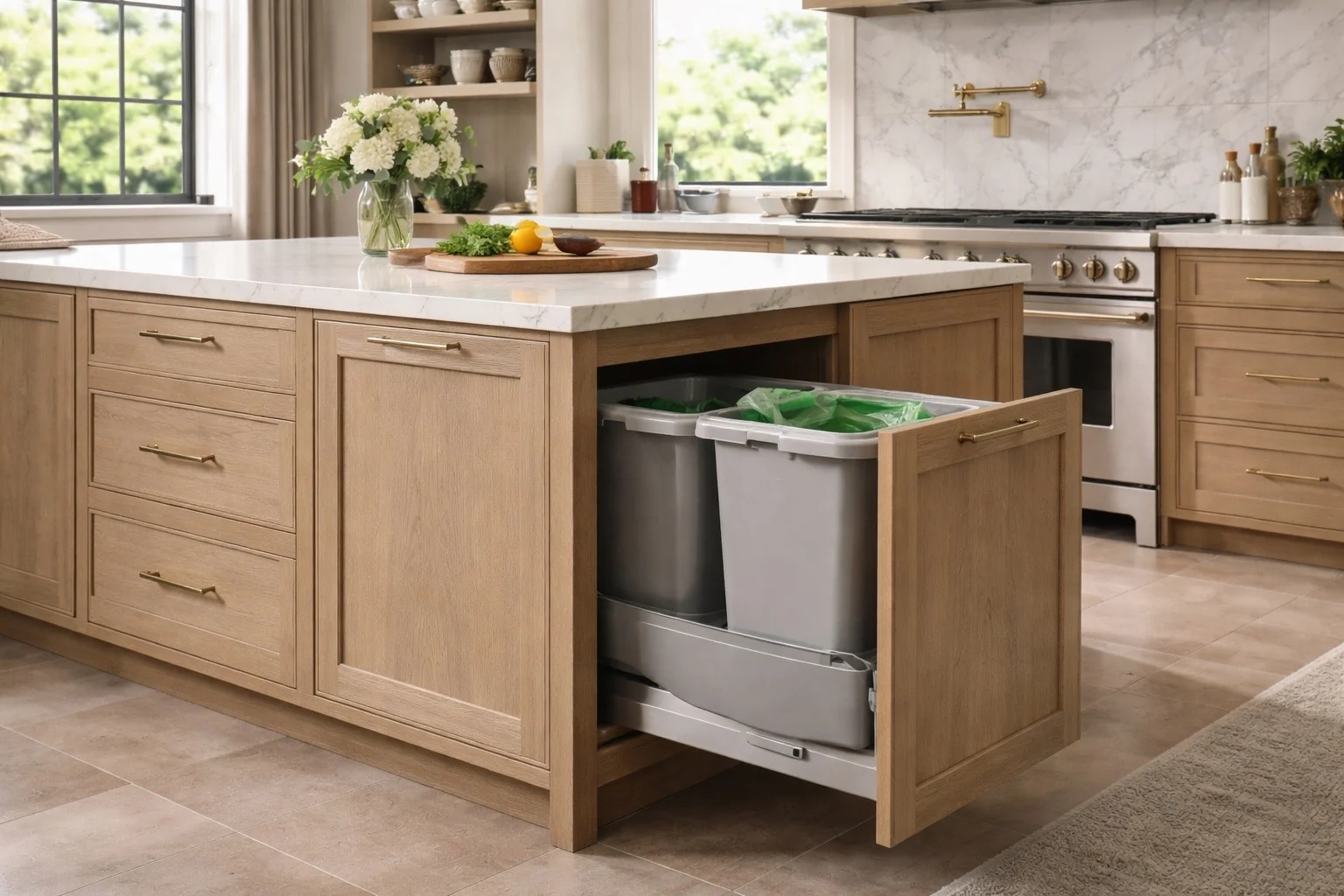
Single-bin, double-bin, recycling, compost, cleanup-zone placement, bin size, soft-close systems, and cleaning realities.
Explore this page →The visible drawer front is the finished face. The drawer box is the structure that carries the contents. When storage planning gets serious, the drawer box matters as much as the organizer because the organizer sits inside the box and adds its own weight, thickness, and clearance requirements.
A common premium cabinet drawer box uses solid maple sides with dovetail joinery, a clear or furniture-grade interior finish, and an undermount guide system. The benefit is strength, a clean interior, and a drawer that reads more finished when opened.
Frameless or full-access construction typically allows more usable drawer-box width because there is less face-frame structure around the opening. This can matter in utensil drawers, wide cookware drawers, and narrow accessory cabinets.
Face-frame cabinetry can still use strong dovetail boxes and full-extension undermount guides, but the face frame affects opening width and drawer-box sizing. The result is often a slightly different usable interior than full-access construction.
Shallow drawers work for cutlery, flat tools, wraps, and small accessories. Mid-height drawers work for utensils and containers. Deep boxes work for cookware, dishes, small appliances, bulk goods, and taller storage inserts.
A roll-out tray is a drawer-like shelf behind doors. It can improve access inside a base or tall cabinet, but it adds hardware, reduces a small amount of interior space, and usually requires enough cabinet depth for the guide system to operate.
Some projects use metal drawer box systems instead of traditional wood dovetail boxes. These can offer very clean sides, high load ratings, sleek modern styling, and coordinated organizer systems, especially in contemporary cabinetry.
Many quality cabinet lines use full-extension undermount soft-close guides. Some standard drawer-guide packages are rated around 75 pounds, while higher-capacity dovetail systems and heavy-duty concealed runners can move into higher ratings. For example, Blum MOVENTO includes 125-pound and 170-pound static-load programs, plus a waste/recycle application with its own rating. The practical takeaway is simple: cookware drawers, dish drawers, large pantries, mixer lifts, and waste pull-outs should be planned as load-bearing storage, not just empty cabinet openings.
The rating also needs context. A static rating describes a load at rest under a test standard. Daily use is dynamic: the drawer is pulled, pushed, extended, closed, sometimes leaned on, and sometimes loaded unevenly. The actual performance depends on drawer width, depth, box construction, fastener holding, cabinet anchoring, accessory weight, installation, and whether the weight is distributed evenly.
The best pull-out is the one that creates a clear daily benefit. If the accessory is hidden, hard to clean, undersized, overloaded, or placed away from the activity it supports, the cabinet may perform worse than a simpler drawer or shelf.
Drawer-like trays installed inside a base or tall cabinet. Useful for cookware, pantry goods, small appliances, and items that would otherwise get trapped behind a door.
Tall or base pull-outs that bring stored food forward. Excellent for visibility, but they can become heavy and should be matched with appropriate guides and stable cabinet construction.
Pull-outs with shelves, rails, or bins for oils, bottles, cleaning supplies, towels, wraps, utensils, or mixed kitchen items. Best when the category is narrow and repeated.
Narrow pull-outs for spices, oils, and small bottles. They work best near the cooking zone but should be protected from excessive heat.
Vertical storage for baking sheets, cutting boards, trays, pans, lids, and platters. Useful when items are tall, flat, and awkward in a drawer.
Heavy-duty lift mechanisms for stand mixers or similar appliances. They free counter space but need cabinet width, strong hardware, and honest weight expectations.
Swing-out, half-moon, LeMans-style, optimizer, or sliding basket systems that trade some storage volume for better access in difficult corner cabinets.
Racks or bins mounted to the door or pull-out front. Helpful for spices, towels, cutting boards, or cleaning supplies when the door and hardware are designed for the load.
Hampers, laundry baskets, broom storage, cleaning pull-outs, paper towel systems, step stools, and household utility solutions that reduce clutter in support spaces.
A roll-out tray behind doors creates two motions: open the doors, then pull out the tray. A deep drawer creates one motion and usually gives a cleaner view from above. Roll-out trays are valuable when the design calls for doors, when a tall cabinet needs layered access, or when the visual rhythm of the cabinet elevation matters.
Deep drawers are often stronger for cookware, dishes, food containers, and everyday items. Roll-outs are often stronger for tall pantry spaces, door-based elevations, or places where interior trays preserve the exterior design language.
Many roll-out systems need a minimum depth to work correctly. Shallow cabinets can limit or eliminate roll-out options. Top sections of tall cabinets are often not ideal for roll-out trays because reach and control become difficult. Highly modified cabinets can also limit accessory options.
Pull-outs need room for guides, the tray or rack, and safe extension. A shallow cabinet may force a false front, reduced tray depth, or no pull-out at all.
Narrow pull-outs can be excellent, but they become less flexible. Wider pull-outs carry more weight and need stronger hardware and careful adjustment.
Doors must open far enough for trays to pull out cleanly. Decorative hardware, adjacent cabinets, appliances, walls, and corner conditions can all interfere.
Sink bases, cooktop bases, oven cabinets, and utility areas can have plumbing, gas, electrical, ducts, or appliance clearances that limit pull-out storage.
A pull-out should be serviceable. If the mechanism cannot be adjusted or removed without damaging the cabinet, maintenance becomes harder.
Accessories planned with the cabinet package can be cleaner when available. Accessories added during installation can add flexibility, but they depend heavily on precise measurement, anchoring, and adjustment.
Pull-outs for spices and towels do not carry the same loads as pull-outs for cookware, pantry goods, small appliances, or waste bins. Heavy pantry pull-outs and mixer lifts need greater care because the weight sits away from the cabinet face when extended. That changes how the cabinet, guides, fasteners, and floor of the cabinet experience the load.
Full-extension guides improve access to the back of the pull-out. Overtravel guides can be helpful in waste or specialty applications where the system needs to move beyond the face of the cabinet. Push-to-open and electric-assist options can be useful, but they add complexity and should be chosen for a clear reason.
A pull-out usually costs more than a fixed shelf because it includes guides, a tray or rack, hardware, mounting, adjustment, and sometimes a door-mount system. The value is strongest where the accessory turns difficult storage into usable storage.
Single roll-out trays, spice pull-outs, tray dividers, and base organizers can be practical upgrades when placed in high-use zones.
Waste pull-outs, pantry roll-outs, mixer lifts, and blind-corner systems can significantly change daily use when properly located and specified.
A pull-out can reduce raw storage capacity because guides, frames, and rails use space. Access may improve even when cubic storage decreases.
Pull-outs need square cabinets, correct anchoring, smooth guide alignment, and door clearances. Poor installation can make even quality hardware feel weak.
Pull-outs can hide storage behind clean cabinetry fronts. This supports a quieter exterior when the client wants less visual clutter.
Moving mechanisms age best when kept clean, correctly loaded, and adjusted. Pull-outs that carry food, waste, or oils need more frequent cleaning.
If a pull-out scrapes, binds, wobbles, or fails to close cleanly, it should be adjusted or inspected. Forcing a misaligned pull-out can damage guides, door attachments, fasteners, and cabinet interiors. Keep tracks clean, avoid overloading, wipe spills quickly, and remove bins or trays for cleaning when possible.
Wipe crumbs and spills before they reach the guide system. Sticky residue can make movement feel rough and attract debris.
Use liners or bins when storing leak-prone bottles. Harsh chemicals should not sit directly on finished cabinet interiors.
Check weight expectations before relying on a lift or roll-out. Do not lean on the shelf or load beyond the intended use.
Clear obstructions before opening. Corner accessories need their full path of travel and should not be overloaded at the outer edge.
A standard drawer is often the cleanest functional solution because it opens in one movement. Pull-outs become more valuable when the design calls for doors, when storage is inside a tall cabinet, or when a specialty mechanism solves a specific access problem.
One motion, direct access, better top-down visibility, strong for daily-use cookware, dishes, utensils, and containers.
Keeps the visual rhythm of doors while improving access behind them. Useful in pantry, utility, and traditional door-based layouts.
Excellent for narrow, defined categories such as spices, oils, trays, cutting boards, towels, cleaners, or waste where the item group is specific.
Highest flexibility and often highest raw capacity. Best for light, larger, or infrequently accessed items where movement hardware is unnecessary.
Improves access to otherwise awkward cabinet volume. Best when the cost and motion complexity are justified by the storage need.
Can make a heavy appliance usable without keeping it on the counter. Best only when the appliance is used often enough to justify the mechanism.
Corners can hold a lot of volume, but not all corner volume is easy to use. The right approach depends on whether the priority is maximum capacity, easier reach, simpler hardware, or a cleaner cabinet layout.
Simple rotating access. Good for pantry goods, bowls, containers, and items that can tolerate a round shelf layout.
A more substantial rotating shelf approach, often stronger and more usable than a light-duty pole-mounted unit when designed correctly.
Pulls hidden storage forward. Strong access improvement, but usually higher cost and more specific fit requirements.
Swinging shelves improve access in certain blind-corner conditions while leaving some volume less fully used.
Can be useful and visually interesting, but they require careful planning and may not fit every design or manufacturer program.
Sometimes the best plan is not to force corner storage. A better run layout, drawers, or adjacent pantry storage can outperform a complicated corner solution.
Tall pantry pull-outs can be excellent because the contents come forward and become visible. They work best when the stored categories are predictable and the load is balanced. Very tall pull-outs filled with cans, jars, and bottles can become heavy quickly, so the guide system and intended load should be respected.
Interior pantry drawers and roll-out trays can sometimes be more flexible than a single large pull-out tower. They allow the pantry to be divided by task: breakfast, snacks, baking, canned goods, oils, paper goods, and backup supplies.
The cabinet style affects pull-out sizing because the pull-out must pass through the actual opening, not the outside cabinet width. Face-frame cabinetry can reduce clear opening at the frame. Full-access cabinetry often provides a wider access rhythm, but still needs hinge, door, and side-clearance review.
Need careful frame-opening review. Roll-outs, waste systems, and interior trays must clear the stiles, rails, hinges, and door swing.
Often allow strong access because there is no traditional face frame, but door overlay, hinge location, and adjacent cabinet alignment still matter.
Require extra attention because the door sits within the frame and pull-out access depends on precise reveal, swing, and interior clearance.
Excellent for pantry pull-outs and interior drawers in lower sections, but top sections may not accept the same roll-out logic.
Width, height, depth, and configuration changes can limit accessory availability. Pull-outs should be confirmed after modifications are known.
Pull-outs in open or glass-door cabinets may expose hardware and unfinished components. Interior finish expectations should be clear.
A standard drawer opens in one motion and gives top-down visibility. An interior roll-out behind doors takes two motions, but can preserve a door-front look or support a pantry cabinet. A narrow pull-out can solve a specific category, but may not offer as much flexible storage as a drawer stack.
Use the hierarchy deliberately: drawers first when they fit the design, roll-outs when hidden access is desired, specialty pull-outs when the category is specific, and fixed shelves when flexibility and volume matter more than movement.
Corners are tempting places for complex accessories. Sometimes that is appropriate. Other times, a simpler layout change, drawer stack, or accessible cabinet run provides more useful storage.
Good for round access and general storage. Less efficient for square items but simple and familiar for many users.
Good for blind corners where shelves swing or slide forward. Capacity and shape should be reviewed against real contents.
Strong access in difficult corners, but higher cost and more hardware. Excellent when the corner would otherwise become unusable.
Useful for more open corner access. Works well for pots, bowls, and bulkier items when the cabinet opening supports it.
Sometimes eliminating a corner cabinet and using drawers elsewhere creates more accessible storage overall.
Occasionally acceptable when the design gains more value from better cabinet runs, appliances, symmetry, or traffic flow.
A strong pull-out plan focuses on the cabinets where fixed shelves would frustrate daily use. We confirm the cabinet, guide system, load expectation, and clearance before the accessory becomes part of the specification.