
Drawer Organization
Cutlery, utensils, spices, knives, plates, wraps, containers, charging, grooming, and drawer-box planning.
Explore this page →Drawer organization is strongest when the drawer box, insert, guide system, and placement all support a specific routine. The goal is not more compartments. The goal is faster access, cleaner storage, and less daily friction.
The key is restraint. A drawer should not be divided so tightly that it only works for one exact set of utensils. It should create enough order to make daily use simple while leaving enough flexibility for real life.
Flatware, utensils, prep tools, knives, spices, wraps, containers, lids, plates, bowls, coffee supplies, charging, grooming items, and office tools.
Drawers let clients look down into storage instead of reaching into the back of a cabinet. The contents are easier to see and easier to retrieve.
Over-customizing a drawer around one exact arrangement can reduce flexibility and make the drawer less useful as routines change.
The insert needs to fit the actual drawer box, not just the visible drawer front. Interior width, depth, and height drive the usable layout.
Good storage is not about adding every available accessory. It is about assigning the right type of storage to the right zone, then confirming that the cabinet, drawer box, guide system, and accessory hardware can support how the space will actually be used.
Cutlery, utensils, spices, knives, plates, wraps, containers, charging, grooming, and drawer-box planning.
Explore this page →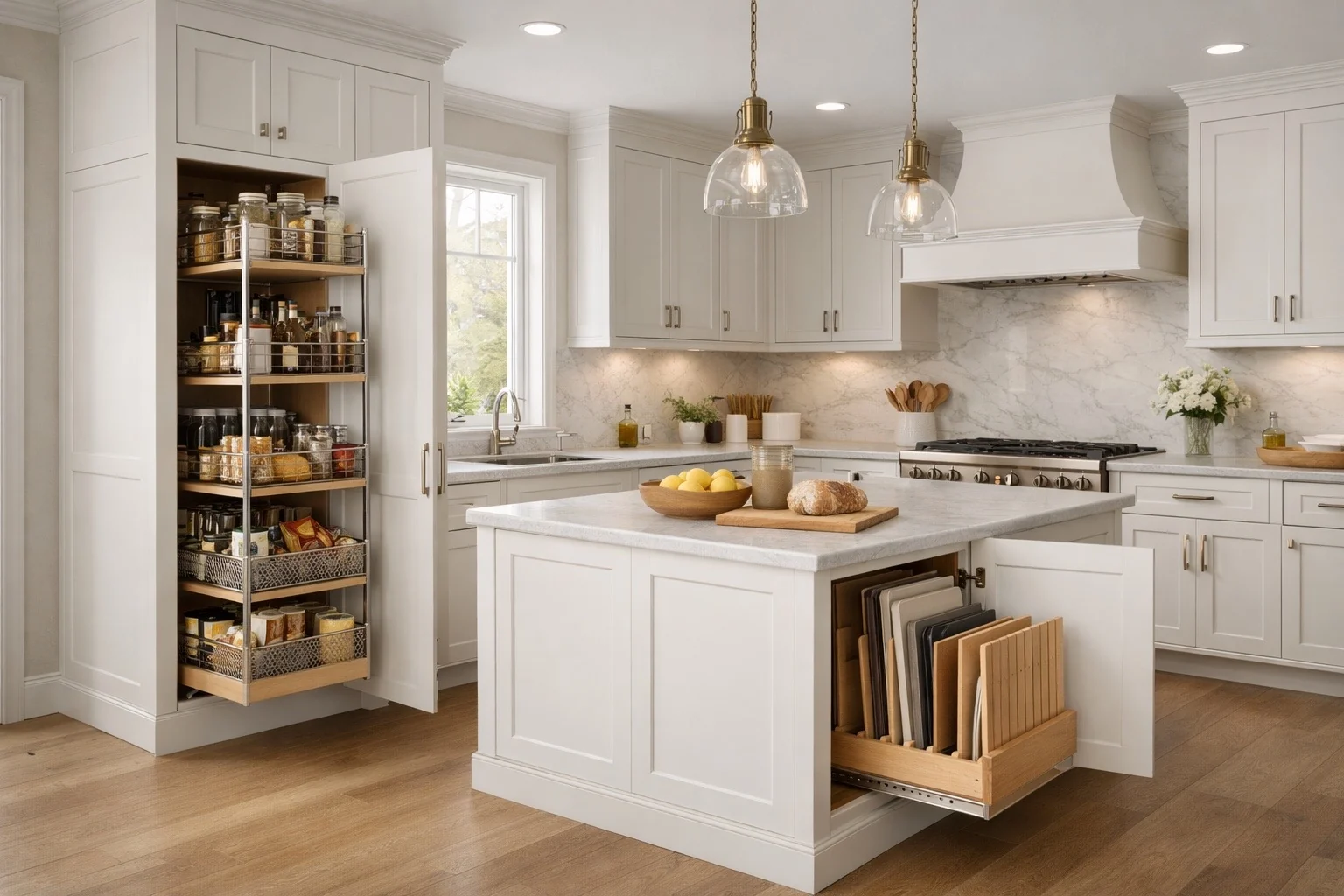
Roll-out trays, pantry pull-outs, spice units, tray dividers, mixer lifts, blind corners, and movement hardware.
Explore this page →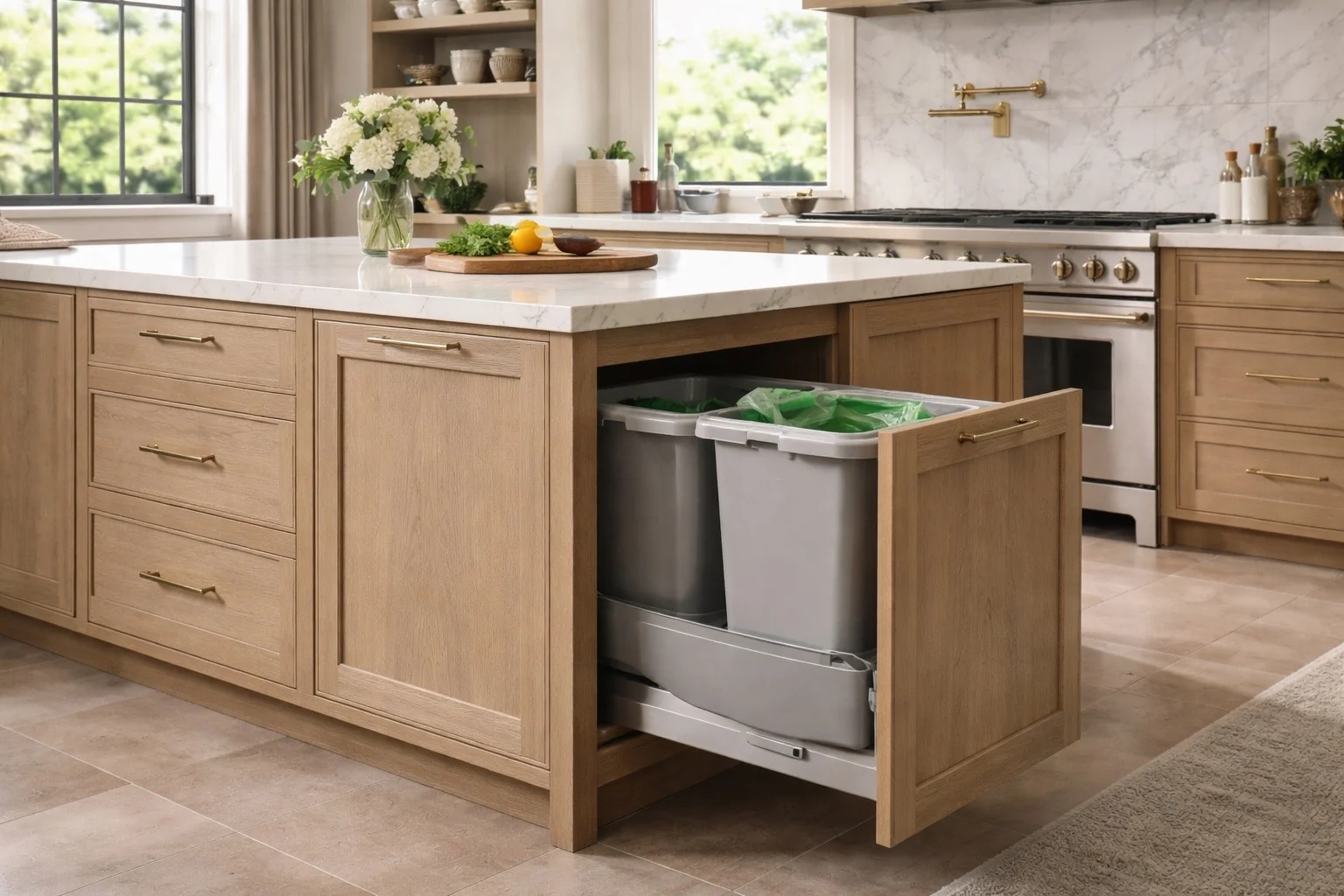
Single-bin, double-bin, recycling, compost, cleanup-zone placement, bin size, soft-close systems, and cleaning realities.
Explore this page →The visible drawer front is the finished face. The drawer box is the structure that carries the contents. When storage planning gets serious, the drawer box matters as much as the organizer because the organizer sits inside the box and adds its own weight, thickness, and clearance requirements.
A common premium cabinet drawer box uses solid maple sides with dovetail joinery, a clear or furniture-grade interior finish, and an undermount guide system. The benefit is strength, a clean interior, and a drawer that reads more finished when opened.
Frameless or full-access construction typically allows more usable drawer-box width because there is less face-frame structure around the opening. This can matter in utensil drawers, wide cookware drawers, and narrow accessory cabinets.
Face-frame cabinetry can still use strong dovetail boxes and full-extension undermount guides, but the face frame affects opening width and drawer-box sizing. The result is often a slightly different usable interior than full-access construction.
Shallow drawers work for cutlery, flat tools, wraps, and small accessories. Mid-height drawers work for utensils and containers. Deep boxes work for cookware, dishes, small appliances, bulk goods, and taller storage inserts.
A roll-out tray is a drawer-like shelf behind doors. It can improve access inside a base or tall cabinet, but it adds hardware, reduces a small amount of interior space, and usually requires enough cabinet depth for the guide system to operate.
Some projects use metal drawer box systems instead of traditional wood dovetail boxes. These can offer very clean sides, high load ratings, sleek modern styling, and coordinated organizer systems, especially in contemporary cabinetry.
A drawer insert should make the drawer more intuitive. It should not make the drawer harder to clean, too narrow for real items, or too specialized for the household.
Best for forks, knives, spoons, serving pieces, and everyday flatware. They work well near the dishwasher or dining zone.
Best for spatulas, tongs, whisks, openers, peelers, and prep tools. Adjustable layouts help because utensil sizes vary widely.
Best when knives need to be protected and kept off the counter. They should allow safe blade orientation and easy cleaning around crumbs.
Best when spices are used often and the cook wants labels visible from above. They need enough drawer depth and should avoid high-heat zones when possible.
Best for plates, bowls, serving dishes, and adjustable dish storage in deeper drawers. They are flexible and helpful near the dishwasher.
Best for lids and containers that otherwise stack poorly. The strongest layouts separate lids from vessels and avoid creating a tangled drawer.
Best for bags, foil, parchment, plastic wrap, and food-prep supplies. They work well near prep or cleanup zones.
Best for K-cups, tea, filters, stirrers, napkins, and bar supplies. Location should relate to the coffee maker, beverage fridge, or serving area.
Best for cords, small devices, tablets, labels, batteries, and office tools. Electrical planning, ventilation, and code-compliant installation must be considered.
Many quality cabinet lines use full-extension undermount soft-close guides. Some standard drawer-guide packages are rated around 75 pounds, while higher-capacity dovetail systems and heavy-duty concealed runners can move into higher ratings. For example, Blum MOVENTO includes 125-pound and 170-pound static-load programs, plus a waste/recycle application with its own rating. The practical takeaway is simple: cookware drawers, dish drawers, large pantries, mixer lifts, and waste pull-outs should be planned as load-bearing storage, not just empty cabinet openings.
The rating also needs context. A static rating describes a load at rest under a test standard. Daily use is dynamic: the drawer is pulled, pushed, extended, closed, sometimes leaned on, and sometimes loaded unevenly. The actual performance depends on drawer width, depth, box construction, fastener holding, cabinet anchoring, accessory weight, installation, and whether the weight is distributed evenly.
Two drawers with the same visible front size can have different interior dimensions depending on construction type, guide system, drawer box style, and whether the drawer is shallow, mid-height, or deep.
Often used for flatware, cooking utensils, wraps, small tools, and low-profile inserts. These drawers benefit from clean dividers and restrained compartment depth.
Useful for larger utensils, containers, small bowls, grooming tools, office supplies, and items that need more vertical space than a top drawer allows.
Useful for pots, pans, dinnerware, mixing bowls, plastic containers, snacks, linens, and heavier categories. They may need peg systems or dividers to keep contents from shifting.
Wide drawers are excellent for cookware and dishes, but they carry more weight. Guide selection and load discipline matter more as width and depth increase.
These are drawer-like trays located inside a cabinet. They improve access behind doors but usually sacrifice a small amount of space to guides, frames, and clearances.
Clear-finished wood boxes feel refined and warm. They should be kept dry, cleaned gently, and protected from standing moisture or aggressive cleaners.
Some cabinetry programs offer premium clear, walnut-look, or coordinated interior materials. These create a more furniture-grade experience when the drawer is opened.
Metal box systems can look crisp, carry strong ratings, and coordinate with modular organizers. They are most common in contemporary or high-function cabinetry packages.
Charging drawers, file drawers, tiered cutlery drawers, plate drawers, and drawer-box inserts need planning beyond the visible cabinet elevation.
Fixed wood inserts can look integrated and calm, especially in a high-end kitchen or bathroom. They make sense when the use is stable: silverware, knives, dedicated spices, or a known set of tools. Adjustable systems are stronger when the contents change: containers, serving pieces, children’s items, coffee supplies, office tools, cosmetics, or multipurpose utility drawers.
The decision should consider not only how the drawer looks today, but whether the drawer will still work in five years. A beautiful insert that is too specific can become a frustration. A flexible insert that is too loose can feel unfinished.
A drawer can be beautifully organized and still be in the wrong place. The correct drawer location usually has more value than a complex insert.
Flatware, plates, bowls, and daily glassware storage can make unloading faster and reduce steps across the kitchen.
Knives, cutting boards, prep tools, wraps, measuring cups, mixing bowls, and food containers support the work zone.
Cooking utensils, pots, pans, oils, spices, and heat-safe tools belong close enough to support cooking without crowding the heat source.
Coffee pods, tea, filters, stirrers, mugs, bottle openers, cocktail tools, napkins, and small serving items can be grouped together.
Hair tools, cosmetics, grooming supplies, towels, and daily essentials should be separated from water-sensitive items and given safe cord management.
Pens, chargers, keys, mail tools, batteries, labels, and technology accessories need structure so the drawer does not become a junk drawer.
Cost increases when inserts are custom-sized, built from finished wood, tiered, integrated with electrical components, coordinated with premium interiors, or designed for specialty categories like knives, spices, plates, files, or charging. Simpler inserts can still be excellent when they solve the routine cleanly.
The important question is not whether a drawer can be divided. The question is whether the division improves how the drawer is used. Some drawers need structure. Others need open space.
Wood inserts should not be soaked. Metal or polymer inserts should be wiped with non-abrasive cloths. Charging drawers need care around cords and ventilation. Knife drawers should be cleared of crumbs. Spice drawers should be cleaned before sticky jars damage the insert or finish.
Overfilled drawers make organizers fail. Items should lift out without scraping, catching, or shifting the insert.
Water, oils, cosmetics, and cleaning residue can damage wood inserts and drawer interiors if left standing.
Heavy plates, cast iron, appliances, and bulk goods need guide capacity and should not be loaded casually into any drawer.
The best drawer is organized enough to be calm and flexible enough to keep working as routines change.
Drawer organization is strongest when the drawer box is selected for the item category first. A beautiful insert cannot fix a drawer that is the wrong depth, height, or load class for the way it will be used.
Use shallow boxes with simple removable dividers. Place near the dishwasher and dish storage. The goal is fast daily access and easy cleaning.
Use wider compartments for longer tools. Avoid narrow bays that only fit a few pieces. Place near the cooking zone but outside heat and splatter.
Use a dedicated knife block or blade-protection insert. Confirm handle height and drawer depth so knives sit safely and do not bind against the drawer above.
Use angled or stepped inserts that keep labels visible. Place near prep or cooking. Confirm spice jar height and drawer clearance before finalizing.
Use deep boxes with pegs, adjustable systems, or dividers. Confirm guide capacity because stacks of plates and bowls can become heavy quickly.
Use deeper drawer boxes and avoid over-partitioning. Large pans and lids need flexible separation more than small compartments.
Separate lids from containers. A simple divider system usually outperforms a fixed tray because container sizes change over time.
Use only when power is planned safely. Confirm outlet location, cable management, heat awareness, and that devices will not be buried under other storage.
Use removable, wipeable organization for grooming tools, cosmetics, razors, brushes, and dental items. Moisture and product residue matter more in vanities than in dry storage.
In face-frame cabinetry, the front frame shapes the opening. The drawer box sits behind that frame, so the usable interior width is often reduced more than clients expect. This matters for wide cutlery inserts, knife blocks, charging drawers, peg systems, and any organizer that needs broad uninterrupted space.
In full-access cabinetry, the lack of a face frame usually allows more usable width inside the same nominal cabinet size. That can make certain drawer organizers feel more generous and can help when planning wide dish drawers, large utensil layouts, or broad storage zones.
Neither construction is automatically better for every project. The key is that organizer planning should reflect the selected construction type rather than assuming every 24 inch cabinet creates the same drawer.
A kitchen drawer, vanity drawer, office drawer, laundry drawer, and bar drawer all hold different items and face different cleaning demands.
Prioritize flatware, prep tools, cooking utensils, spices, knives, dish drawers, cookware, food containers, wraps, bags, and towels.
Prioritize visibility and grouping: snacks, cans, dry goods, baking, spices, bulk storage, coffee, tea, and lunch prep.
Prioritize grooming tools, cosmetics, hair tools, dental storage, razors, towels, and cleaning items with moisture-aware planning.
Prioritize detergents, stain tools, lint rollers, sewing kits, garment care, pet supplies, and utility items that benefit from washable organization.
Prioritize filters, capsules, tea, stirrers, napkins, bottle tools, cocktail tools, coasters, and glassware support.
Prioritize mail, keys, chargers, devices, stationery, files, glasses, wallets, and small daily carry items that otherwise collect on counters.
A kitchen drawer, vanity drawer, office drawer, pantry drawer, laundry drawer, and bar drawer can all use the same drawer-box principles, but the organizer logic is different. Start with the room’s repeated routine, then choose the drawer box and insert.
Flatware, utensils, knives, spices, wraps, containers, plates, bowls, cookware, baking tools, and coffee supplies need task-zone placement and sensible weight planning.
Dry goods, snacks, cans, baking ingredients, breakfast items, and small appliances need visibility and enough depth without becoming overloaded.
Grooming tools, makeup, brushes, hair tools, towels, and personal care items need moisture awareness and practical removable organizers.
Files, chargers, supplies, paper, devices, and small electronics need clear categories and, when needed, purpose-built file or charging hardware.
Detergent supplies, lint tools, clothespins, sewing kits, cleaning cloths, pet items, and household overflow need wipeable and flexible organization.
Pods, filters, stirrers, cocktail tools, napkins, bottle openers, bar accessories, and small serving pieces work best when placed near the beverage zone.
Clients often judge drawers by the exterior front style, but the daily experience comes from the drawer box, guide system, and interior layout. A five-piece drawer front, slab drawer front, inset drawer front, or full-overlay drawer front can all conceal a very different interior storage condition. The cabinet construction determines clear opening, drawer box size, reveal, and how much usable interior space remains.
That distinction matters when choosing inserts. A drawer front may look wide from the outside while the actual drawer box is narrower because of cabinet construction, guides, face frame, or double-drawer layout. Inserts should be planned from the interior drawer box dimension, not from the outside face width.
Before drawer organization is finalized, the client should understand what will live in each major drawer group. These questions prevent beautiful but impractical storage.
Daily-use items deserve the best drawer locations. Occasional-use items can live farther from the main work zone.
Dishes, cookware, cast iron, bulk pantry goods, and appliances need guide-rating awareness and balanced loading.
Coffee, snacks, oils, spices, grooming products, and crafts benefit from removable inserts or easier-clean surfaces.
Families, cooking habits, dish sets, and routines change. Adjustable organization may be better than permanent compartmenting.
Knives, glassware, specialty tools, plates, electronics, and delicate items may need dividers, pegs, or dedicated trays.
Chargers, mail, wraps, lids, clutter categories, and small tools often need drawers because open counters invite visual noise.
Drawer organization is most valuable in the drawers that shape the daily rhythm of the room. We plan those first, then decide which lower-frequency drawers need simple open storage versus tailored inserts.