Hinges
Concealed hinges, semi-concealed hinges, specialty hinges, wide-angle hinges, glass hinges, and inset-specific hinges affect door swing, adjustment, reveal control, and clean alignment.
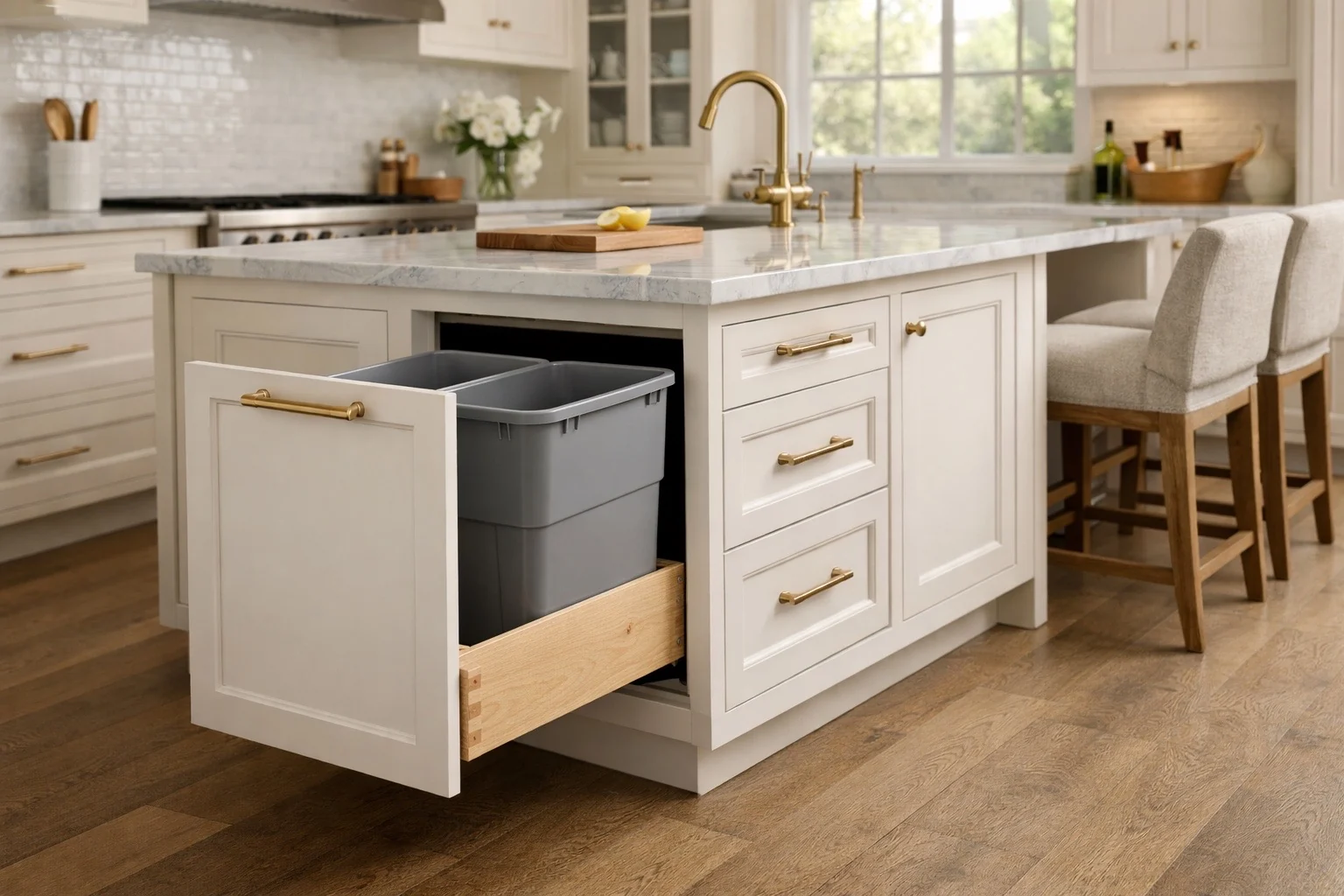
Hinges, drawer slides, opening systems, pull-outs, lift hardware, touch-latch systems, internal accessories, and support hardware determine how the cabinetry actually performs. The best functional hardware feels integrated, not gadget-driven.
Clients may notice cabinet color first, but they live with drawer movement, door swing, access, soft-close behavior, cabinet reach, and internal organization every day. Functional hardware should solve real friction points without overcomplicating the room.
Busy kitchens, pantries, laundry rooms, bars, vanities, aging-in-place planning, heavy drawers, deep storage, and clients who value everyday ease.
Functional hardware can improve access, reduce door and drawer slam, support heavier loads, and make deep or awkward cabinets more useful.
Accessory overuse, clearance conflicts, lost interior space, weight limits, retrofit difficulty, and mechanisms that do not match the client’s actual routine.
Mechanisms selected early enough that the cabinet design, dimensions, clearances, and installation details all support the hardware properly.
This category is broader than soft-close hinges. It includes the physical parts that let doors, drawers, panels, and internal accessories move properly, safely, and repeatedly.
Concealed hinges, semi-concealed hinges, specialty hinges, wide-angle hinges, glass hinges, and inset-specific hinges affect door swing, adjustment, reveal control, and clean alignment.
Undermount, side-mount, soft-close, full-extension, overtravel, and heavy-duty slides determine how drawers move, how much they can carry, and how much access the client gets to the back of the drawer.
Lift-up doors, vertical lift systems, touch-latch hardware, push-to-open systems, flipper doors, pocket doors, and specialty opening systems can improve access in specific locations.
Trash pull-outs, spice pull-outs, tray dividers, base cabinet pull-outs, pantry pull-outs, and under-sink pull-outs bring stored items forward instead of forcing the client to reach deep into the cabinet.
LeMans-style trays, lazy Susans, blind-corner pull-outs, magic-corner systems, and swing-out hardware can recover awkward storage, but they must be planned around cabinet dimensions and clearances.
Shelf pins, locks, latches, levelers, catches, bumpers, stays, brackets, organizers, and integrated power or lighting support the finished cabinet system even when they are not visually prominent.
Hinges do more than attach a door to a cabinet. They influence door swing, access angle, soft-close behavior, adjustability, overlay, inset fit, reveal consistency, and whether adjacent doors, fillers, walls, or appliances conflict when opened.
Concealed hinges are common in modern cabinetry because they provide adjustability and a clean exterior. Inset cabinetry, face frame full overlay cabinetry, glass doors, angled cabinets, and specialty applications may require different hinge types. The hinge should be chosen for the construction style and door function, not assumed as a default part.
A drawer that opens smoothly, extends fully, carries weight confidently, and closes softly changes how a kitchen, pantry, or vanity feels every day. A weak drawer slide can make premium cabinetry feel underbuilt even if the visible finishes are beautiful.
The slide specification should reflect drawer width, expected load, drawer box construction, use frequency, and installation conditions. Heavy cookware, pantry goods, trash units, and wide drawer banks place different demands on hardware than light storage drawers or display areas.
A good access solution brings storage into reach, reduces bending or searching, and makes the cabinet more useful. A poor access solution adds moving parts, cost, and space loss without improving the client’s routine.
These are high-value in many kitchens because they support prep and cleanup routines. They should be located where the client naturally works, not just where a base cabinet happens to be available.
Pull-outs can improve access in deep base cabinets, but they reduce some interior volume because the mechanism and clearances occupy space.
Pantry mechanisms improve visibility and access, especially in tall cabinets. Load rating, clearances, and door swing should be reviewed carefully.
Corner hardware can improve awkward storage, but it is not always magic. It needs the correct cabinet dimensions and may still sacrifice some usable volume.
Lift systems can work well for appliance garages, wall cabinets, and modern door designs. They should be checked for reach, ceiling height, cabinet height, and user comfort.
Push-to-open hardware can create a clean no-pull look, but it requires cabinet-front discipline and may not be ideal for every user, every drawer, or every high-touch kitchen zone.
Functional upgrades can add real value when they support the way a client cooks, stores, cleans, reaches, and moves through the room. Full-extension drawer slides, soft-close doors, correctly located waste pull-outs, and strong pantry hardware can improve everyday performance more than a purely decorative upgrade.
The caution is over-specification. Not every cabinet needs an accessory. Some inserts reduce storage volume. Some mechanisms add maintenance and adjustment points. Some specialty systems require very specific cabinet dimensions and clearances. The right plan is selective, practical, and tied to actual behavior.
Many mechanisms cannot simply be added at the end. Cabinet width, depth, side clearance, door swing, drawer box design, weight, and adjacent conditions all affect whether functional hardware will work correctly.
Pull-outs, bins, dividers, and mechanisms consume space. They can improve access while reducing raw storage volume.
Slides, hinges, lifts, and pull-outs have load limits. Heavy cookware, pantry goods, appliances, and large panels must be matched with appropriate hardware.
Doors, drawers, pull-outs, appliance handles, walls, fillers, islands, and adjacent cabinets can interfere with movement if clearances are not reviewed.
Hinges, slides, and mechanisms can require alignment after installation, after settling, or after heavy use. Good hardware still needs correct installation and occasional attention.
Push-to-open, lift-up doors, and touch latches are not universally preferred. Some clients like the clean look; others find the daily interaction less natural.
Adding functional hardware later may require new cabinets, modified boxes, replacement fronts, new drawers, or reduced clearances. Early specification is safer.
Most hardware failures begin as small alignment or use problems: a drawer overloaded with cookware, a pull-out forced around an obstruction, a door repeatedly slammed into an adjacent handle, or a hinge allowed to sag until reveals become uneven. Early correction protects the cabinet and the hardware.
Clients should treat functional hardware as moving equipment inside the cabinetry. It should feel smooth, aligned, and controlled. If it binds, scrapes, drops, slams, or requires force, something needs to be adjusted or reviewed.
Early decisions protect cabinet dimensions, reveal planning, door swing, drawer sizing, appliance panels, internal clearances, and installation expectations. Late decisions often cost more or force compromises.
Map cooking, cleanup, prep, coffee, baking, pet, entertaining, laundry, vanity, or storage routines before choosing mechanisms.
Find deep storage, heavy items, awkward corners, trash needs, reach concerns, and cabinets that need full access or special movement.
Choose slides, hinges, pull-outs, lifts, or organizers because they solve a specific issue, not because the accessory sounds premium.
Confirm cabinet width, depth, side clearances, door swing, overlay, drawer box size, and load requirements before final order.
Functional movement must work with decorative pulls, appliance handles, adjacent openings, and traffic paths.
Expect alignment review during installation and occasional adjustment after normal settling or heavy use.
The right functional hardware reduces friction. It puts trash where cleanup actually happens. It lets drawers carry the weight they are meant to carry. It makes upper storage easier to reach. It prevents door and drawer movement from feeling cheap or uncontrolled. It keeps daily access from becoming a negotiation with the cabinet.
The wrong functional hardware adds complexity without solving a real problem. A premium room does not need every mechanism available. It needs the correct mechanisms in the correct locations, designed into the cabinetry before the project becomes difficult to change.
The best mechanisms are planned early, matched to real routines, installed with proper clearances, and selected because they solve a specific access, movement, or durability problem.