Knobs
Knobs are compact, traditional, and often useful on doors or small drawers. They can feel quiet and classic, but they may be less comfortable on heavy drawers or oversized fronts.
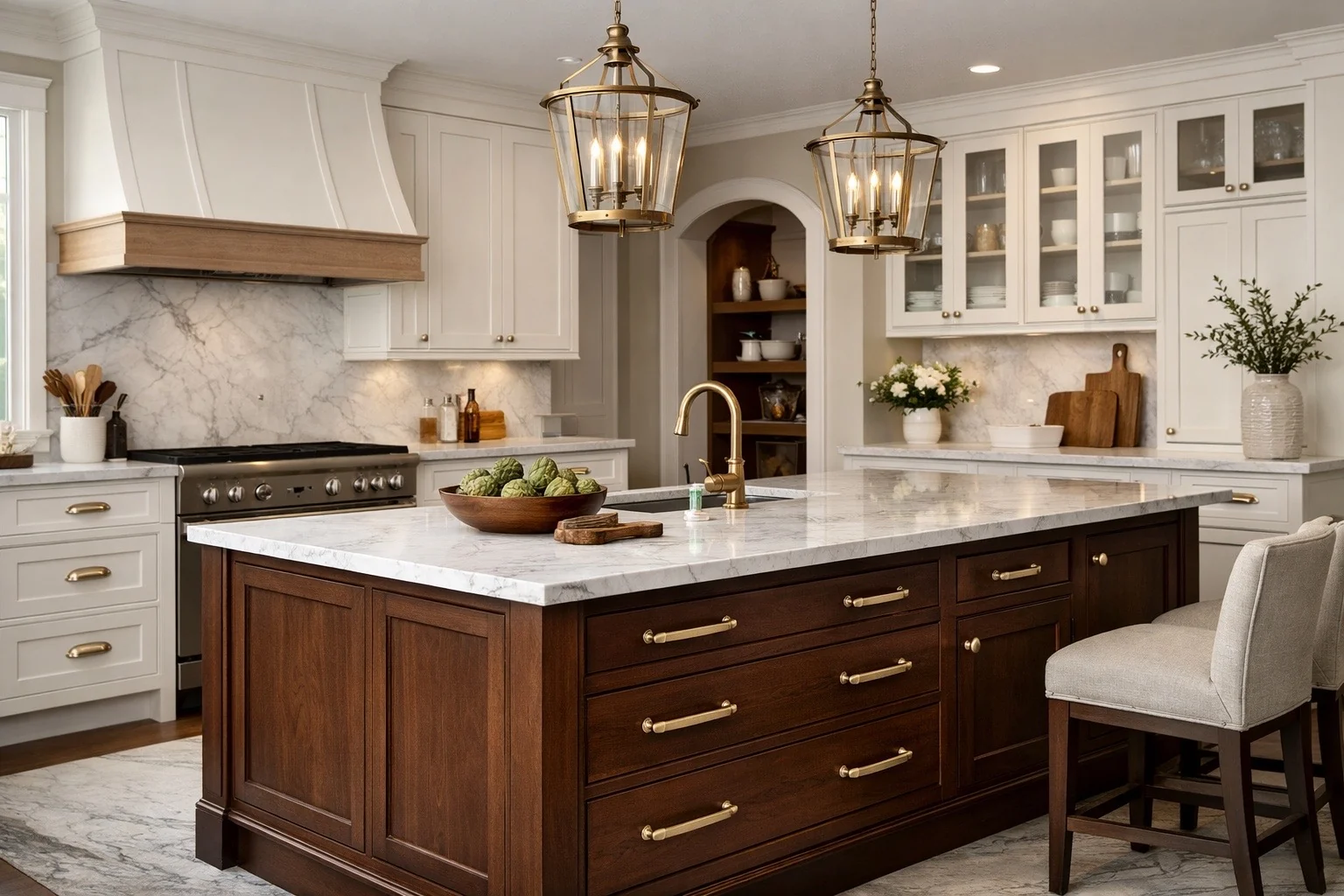
Knobs, pulls, cup pulls, tabs, latches, backplates, and appliance pulls can make cabinetry feel quiet, classic, modern, tailored, or highly decorative. The right selection should look correctly scaled, feel comfortable, coordinate with the full palette, and support the room instead of distracting from it.
The right hardware supports the cabinet design so naturally that it feels inevitable. The wrong hardware draws attention for the wrong reason: too small, too large, too shiny, too busy, uncomfortable to grip, difficult to clean, or disconnected from the room’s finishes.
Clients who want cabinet faces to feel finished, tailored, and intentionally coordinated with lighting, faucets, appliances, and cabinet finish.
Decorative hardware can noticeably elevate cabinetry without changing the cabinet box, door style, or countertop material.
Scale, finish mismatch, uncomfortable grip, excessive projection, wrong drilling size, and overusing statement hardware.
Hardware that has the right size, weight, finish, and placement for the specific door, drawer, appliance panel, and room composition.
A well-planned room may use one type of hardware everywhere, or it may use a controlled mix. The goal is not variety for its own sake. The goal is a clear hierarchy that makes the cabinetry easier to read and easier to use.
Knobs are compact, traditional, and often useful on doors or small drawers. They can feel quiet and classic, but they may be less comfortable on heavy drawers or oversized fronts.
Pulls provide better grip and stronger horizontal or vertical rhythm. They work well on drawers, tall doors, slab fronts, and rooms where scale needs to feel more tailored.
Appliance pulls are larger, heavier visual anchors used on panel-ready refrigerators, dishwashers, freezers, and tall integrated panels. They should be scaled to the appliance, not treated like ordinary cabinet pulls.
Cup pulls introduce a classic, furniture-like, or cottage-influenced language. They can look excellent on drawers, but they should be checked for hand comfort and cleaning access inside the cup.
Tab pulls create a quieter modern detail and can reduce visual clutter. They require careful placement and may not offer the same grip comfort as a traditional pull.
Latches and backplates add historic or furniture-grade character. They can be beautiful in edited doses, but they increase visual detail and must be carefully coordinated with door profiles.
A hardware piece can look perfect in the hand and still look wrong on a 36-inch drawer, a tall pantry door, or a panel-ready refrigerator. Proportion is created by the relationship between hardware length, cabinet width, door style, rail and stile size, adjacent openings, and the amount of negative space on the cabinet face.
Smaller knobs and pulls can feel classic and quiet, but they may look under-scaled on wide drawers or oversized modern doors. Longer pulls can feel tailored and premium, but they can also overpower small doors or create a busier rhythm if every cabinet receives the same length without consideration.
A room can use one hardware finish throughout, or it can use a controlled mix. The difference between intentional and accidental is whether the hardware relates clearly to the faucet, lighting, appliances, cabinet finish, countertop, backsplash, and door style.
Warm, tailored, and strong against white, cream, navy, green, walnut, oak, and many painted finishes. The exact tone matters because champagne, satin brass, aged brass, unlacquered brass, and bright gold do not read the same.
Nickel can feel warm and classic, while chrome reads brighter and cooler. These finishes often coordinate well with plumbing, polished stone, cooler palettes, and traditional or transitional cabinetry.
Black creates clear contrast and can sharpen a room quickly. It is powerful against light cabinetry but may show oils, hard-water spotting, dust, and edge wear depending on the finish and use zone.
Bronze can add depth, age, and warmth. It can work beautifully in traditional, rustic, Mediterranean, and transitional rooms, but the undertone should be reviewed against lighting and faucet selections.
Stainless, pewter, and graphite-like finishes can connect to appliances and cooler cabinetry palettes. They often feel quieter than black and less warm than brass.
Mixed metals can work when each finish has a reason. A common structure is one dominant finish and one supporting finish, rather than hardware, faucet, lighting, and appliances all competing equally.
A single knob or pull may seem modest, but a kitchen, pantry, bar, laundry room, or full-home cabinetry package can require dozens or hundreds of pieces. Long pulls, appliance pulls, backplates, specialty finishes, solid materials, imported collections, and split-finish hardware can raise the total quickly.
That does not mean hardware should be treated as an afterthought. It means the plan should be deliberate. Spend where the hardware is most visible, most touched, most structurally important, or most responsible for the design language. Keep less visible areas quieter when the room does not need the extra detail.
Hardware should be chosen with the cabinet construction and finish in mind. A pull that looks refined on a flat slab may feel too modern on a beaded inset door. A traditional knob may look charming on an inset vanity but underpowered on a wide frameless drawer bank.
Shaker doors tolerate a broad range of knobs and pulls. The profile is simple enough for many styles, but the hardware should still respect rail and stile proportions.
Slab fronts make hardware scale and placement more visible because there is no frame detail to absorb mistakes. Long pulls, edge pulls, or push-to-open details can all work depending on the intended look.
Inset cabinetry often benefits from hardware with furniture-grade character. Knobs, latches, cup pulls, and refined pulls can reinforce the tailored nature of the construction.
Full overlay cabinetry can read clean and transitional. Pull length, placement, and finish should support the tighter front elevation without making the cabinet face feel crowded.
Wood grain already carries visual information. Hardware should either quietly support the wood tone or create intentional contrast without fighting the material character.
Painted cabinetry gives hardware finish more influence. Black, brass, nickel, bronze, and chrome can each change the mood of the same cabinet color significantly.
Cabinet hardware placement is a permanent visual decision because drilling creates fixed holes in doors and drawer fronts. A change from knobs to pulls, or from one pull size to another, may not be possible without exposing old holes or replacing fronts.
Good placement considers user reach, cabinet function, door swing, drawer width, profile geometry, appliance requirements, and visual alignment across the elevation. The goal is a pull schedule that feels consistent without becoming mechanical or blindly repetitive.
A soft cloth, mild soap, clear water, and prompt drying are usually safer than aggressive cleaning. Cabinet hardware is often protected by a finish coating, plating, or patina system. Abrasive cleaners and harsh chemicals may remove, cloud, or weaken that finish layer.
The finish selected should match the client’s tolerance for natural change. Some clients love patina, edge burnishing, and aged warmth. Others want hardware that stays as uniform as possible. That preference should be known before the order is placed.
The correct piece should look right from across the room, feel right when used, and still make sense when viewed against the actual cabinet finish, countertop, backsplash, faucet, lighting, flooring, and appliance package.
Does the hardware strengthen the cabinet elevation, or does it distract from the architecture of the room?
Does the length and projection feel appropriate on small drawers, wide drawers, tall doors, and appliance panels?
Does the finish relate clearly to faucet, lighting, appliances, cabinet color, countertop, and backsplash?
Can the client comfortably open the cabinet with dry hands, wet hands, one hand, and repeated daily use?
Will the shape collect grime, show spotting, or frustrate cleaning in the exact room where it will be used?
Will the hardware still feel appropriate after current trends shift, or is it carrying too much of the room’s personality?
Correct scale, finish coordination, grip comfort, and placement turn hardware from a small selection into a major finishing layer of the room.